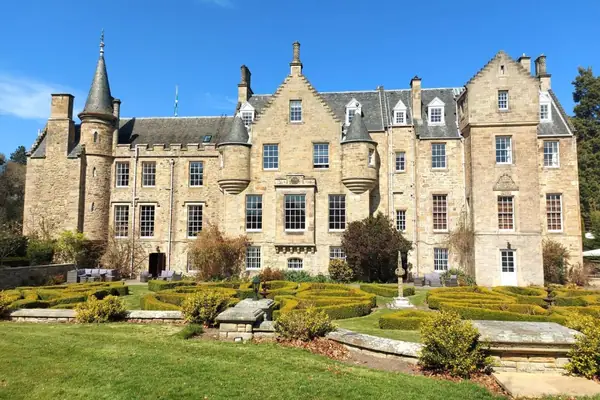
Level 4 Castle-Style Mansion
Carberry Tower Mansion House and Estate
Musselburgh, East Lothian
- Restaurant
- Family rooms
Guide
Scottish Baronial is a building style that copies the outline of Scotland's fortified tower houses: corbelled turrets, crow-stepped gables, bartizans and conical roofs on a tall, harled main block. The term covers two different periods, the genuine tower houses of the 16th and 17th centuries and the 19th-century revival mansions built to look the same way, which is why two Baronial buildings can have completely different histories.
Scottish Baronial describes a building that reads as a castle from a distance: a tall main block, round or square turrets carried on stone brackets at the corners, and a broken roofline of small windows and conical caps. The name covers two different things. One is the tower houses Scottish lairds actually built and defended between the 14th and 17th centuries. The other is the 19th-century style that copied their outline once defence was no longer the point.
Heritage bodies mostly use Scottish Baronial for the second group, the Victorian and Edwardian revival. The listing for Abbotsford House near Melrose, built in phases from 1816 to 1824 for the novelist Walter Scott, describes it as a pioneering Baronial Revival country house and the first attempt to recreate an authentic Scottish castle rather than a generic Gothic one. Abbotsford's architects were William Atkinson and Edward Blore, with later work by the builder John Smith of Darnick and the architect William Burn.
From the 14th century, Scottish landowners built tower houses: tall, narrow stone buildings, often with one room per floor, designed first to be defended and second to show status. As the country grew more settled through the 16th and 17th centuries, towers gained wings, courtyards and bigger windows without losing their castle silhouette. Carberry Tower near Musselburgh is one surviving example of that pattern: a 16th-century tower with a large extension added to the south in the late 17th century.
The style fell out of use in the 18th century in favour of classical Georgian design, then returned at Abbotsford. Scott's house borrowed crow-stepped gables, a corner tower, bartizans and machicolation from real Scottish castles he had studied, rather than a generic Gothic front.
Queen Victoria and Prince Albert confirmed the revival when they had Balmoral Castle in Aberdeenshire rebuilt from 1853, completed in 1856, by the Aberdeen architect William Smith, working from plans Albert amended himself. Balmoral, listed by Historic Environment Scotland as a Category A building along with its parterre and terrace walls, is described in the register as Scottish Baronial architecture with conical granite towers, bartizans and crow-step gables. After Balmoral, Baronial became the standard choice for a new Scottish country house, and it stayed in fashion until the First World War.
David Bryce did more than any other single architect to spread the style. He joined the Edinburgh office of William Burn in 1825 and went on to design more than 230 buildings, many of them Baronial. His work includes Glenapp Castle in South Ayrshire, built in 1870, and the mansion now run as Glengarry Castle Hotel at Invergarry, designed in the 1860s.
Level 4 Castle-Style Mansion
Musselburgh, East Lothian
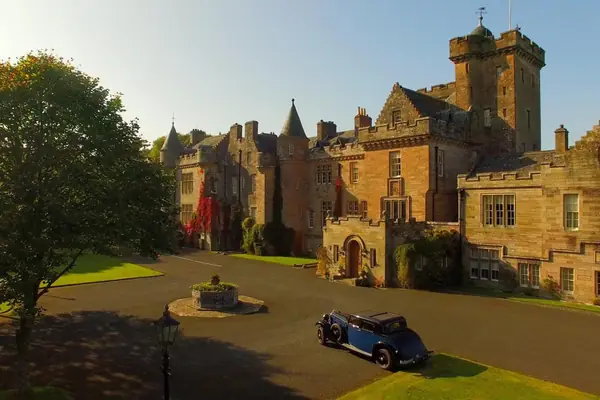
Level 4 Castle-Style Mansion
Ballantrae, South Ayrshire
Some rooms inside the walls
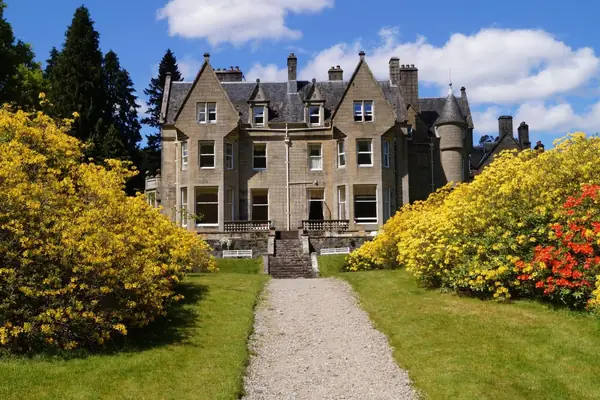
Level 4 Castle-Style Mansion
Invergarry, Highland
Rooms outside the historic walls
A small set of details recur on almost every Baronial building, genuine or revived. Corbelled turrets, small round or square towers carried on projecting stone brackets rather than rising from the ground, sit at the corners and break up an otherwise plain wall. Their conical roofs, along with the steep gables and dormers of the main roof, give the building its uneven skyline. The listings for Balmoral and for Sherbrooke Castle Hotel in Glasgow both use this vocabulary, describing bartizans, a cap-house and conical-roofed angle turrets.
Crow-stepped gables, where the edge of the gable rises in a stair-step of rectangular stone blocks rather than one continuous slope, are among the most recognisable features of Scottish building generally, according to the glossary compiled for the University of Glasgow's Mackintosh Architecture project. Harling, a rough lime-and-aggregate render thrown onto a wall rather than trowelled smooth, is the traditional Scottish weatherproofing and gives many Baronial buildings their pale, textured finish. Kincraig Castle Hotel near Invergordon is one example, described on its own site as a white-harled building with crow-step gables and turrets.
Machicolations, projecting stone galleries with openings in the floor once meant for dropping objects on attackers below, appear on some revival buildings purely as decoration long after anyone needed them for defence, as at Abbotsford. Bartizans, small turrets that project from a wall or parapet rather than sitting on the roofline, do a similar job: they give a building the outline of defence without the function.
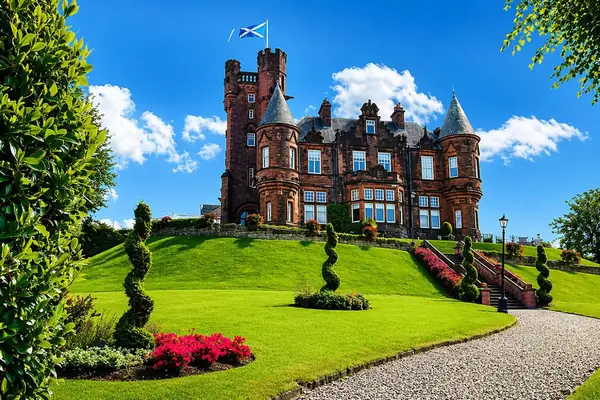
Level 4 Castle-Style Mansion
Pollokshields, Glasgow
Some rooms inside the walls
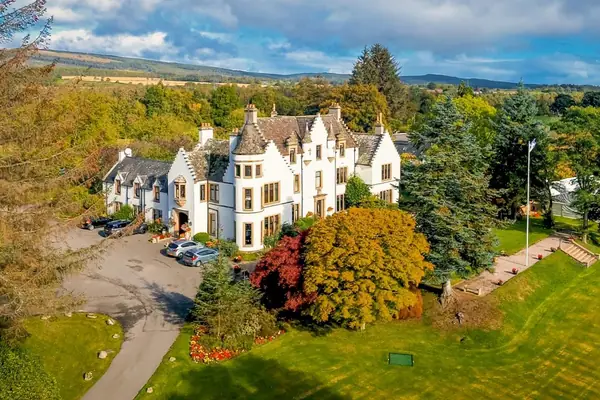
Because Scottish Baronial spans four centuries, two buildings that look alike from the drive can have opposite histories. A 16th or 17th-century tower house was built to be defended, at least briefly, and its walls, stairs and windows usually show it: thick walls, a turnpike stair, and window openings that get larger the higher up the building you go, once the risk of attack falls away. A 19th-century Baronial mansion carries the same turrets and crow-steps, but was built for comfort and display from the start, with wide sash windows, a symmetrical front and rooms sized for entertaining rather than defence.
This is the distinction behind our Castle Authenticity Scale. Level 5, True Castle, is for buildings put up as a castle, tower house or fortified house between the medieval period and the 17th century, where guests sleep inside those historic walls. Level 4, Castle-Style Mansion, covers 18th-century or later buildings in castle style, Scottish Baronial included, with no defensive history, plus any early castle so heavily rebuilt that the fabric guests sleep in today is essentially later work. Without one, we leave the level blank rather than guess.
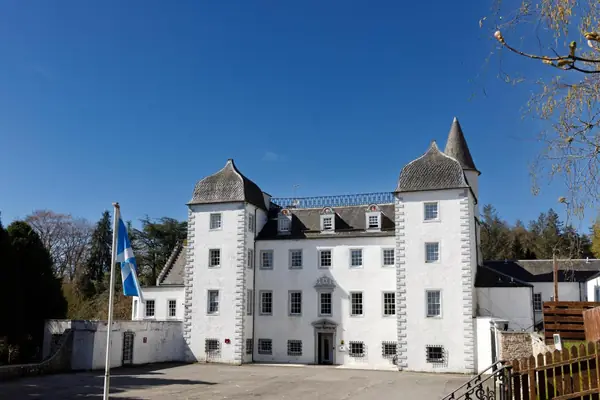
Carberry Tower shows how mixed a single building can get. Its core is a 16th-century tower, but a south range was added in the late 17th century, an east range by David Bryce around 1860, and Baronial detailing by the architect Thomas Ross in 1909 and 1913. Tulloch Castle at Dingwall is similarly layered: the square tower at its centre dates from the 16th century, with alterations from the 17th to the early 20th century, including work by A. Maitland and Sons in 1891 and by Sir Robert Lorimer between 1920 and 1922. Barony Castle near Peebles, also known as Black Barony, began as a Scots baronial building of 1536 on the site of an earlier peel tower, before a Jacobean facade was added between 1700 and 1715. In each case, guests sleep inside a genuine historic core with later additions, not a building put up only to look like a castle.
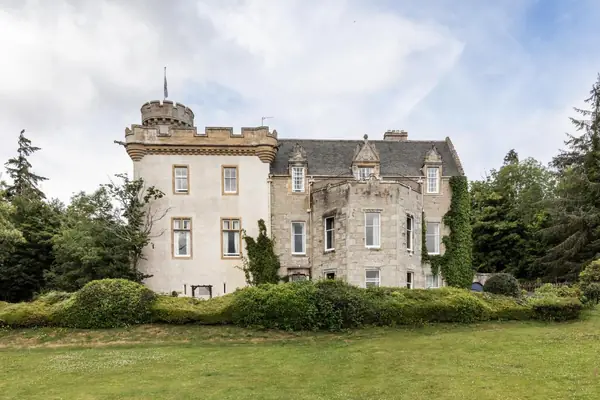
Castle hotel
Dingwall, Highlands & Islands
A group of hotels across Scotland occupy 19th-century Baronial mansions with no defensive history at all. Fonab Castle Hotel at Pitlochry was designed by the architect Andrew Heiton in 1892 for Lieutenant Colonel George Glas Sandeman and is a Category B listed building. Inverlochy Castle Hotel near Fort William, a separate building from the ruined 13th-century Inverlochy Castle about two miles (3 km) away, was built in 1863 for William Scarlett, third Baron Abinger, and is Category B listed as Inverlochy Castle Hotel, including its former stables and walled garden. Glengarry Castle Hotel at Invergarry occupies the former Invergarry House designed by David Bryce.
Stonefield Castle Hotel on Loch Fyne was built around 1837 to a design by William Playfair for John Campbell, with towers and carved stonework, and is Category B listed. Glenapp Castle near Ballantrae is another David Bryce design, built in 1870 for James Hunter and Category B listed since 1971. On the Isle of Mull, Glengorm Castle was designed by the Edinburgh firm Kinnear and Peddie and completed in 1860 for James Forsyth, and has been Category B listed since 1971.
Two hotels show the style spreading into towns as well as estates. Sherbrooke Castle Hotel in the Pollokshields area of Glasgow was built in 1896 by the architects Thomson and Sandilands as a private house, with a tall corner tower, bartizans and crow-stepped gables, and became a Category B listed building in 1990. Mansfield Castle Hotel at Tain dates from about 1875, with a three-stage Baronial tower and angle turrets added by A. Maitland and Sons in 1902, and is Category B listed. Kincraig Castle Hotel near Invergordon, a Category C listed building, had its crow-step gables and turrets added in a later baronial phase, largely attributed to the same Maitland firm. None of these three had a defensive history: all are 19th-century mansions built to look like a castle rather than to be one.
Between the two extremes sit hotels such as Carberry Tower and Tulloch Castle, described above, where a genuine tower house carries later Baronial additions. For a wider view of where these buildings sit, see castle hotels in Scotland, or the regional hubs for the Highlands and Islands and Perthshire, Angus and Dundee, where several of these hotels are.
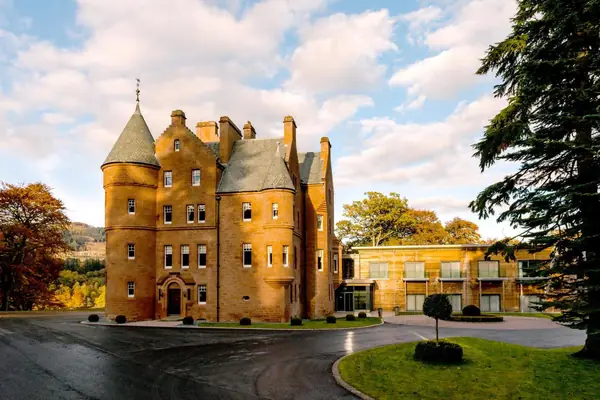
Level 4 Castle-Style Mansion
Pitlochry, Perthshire
Some rooms inside the walls
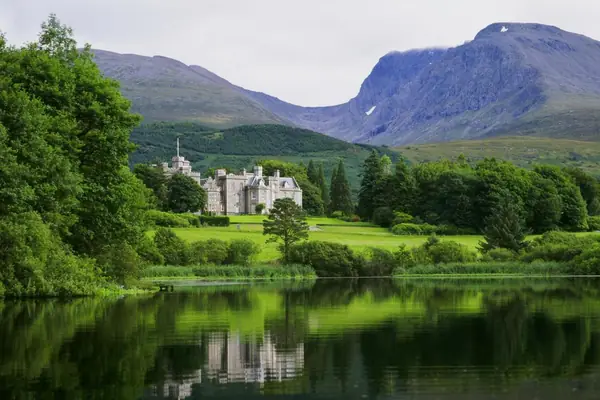
Level 4 Castle-Style Mansion
Torlundy, Fort William, Highland
Some rooms inside the walls
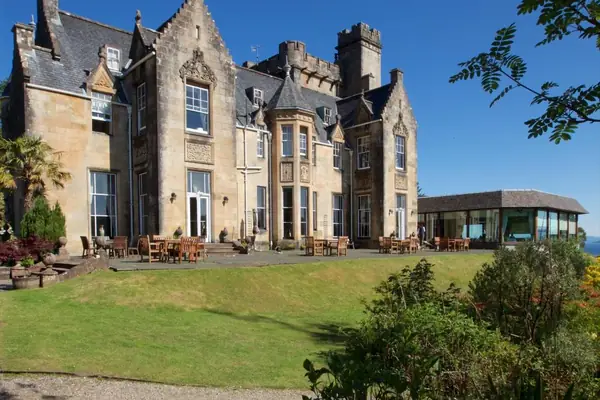
Level 4 Castle-Style Mansion
Tarbert, Loch Fyne, Argyll and Bute
Sleep inside the walls
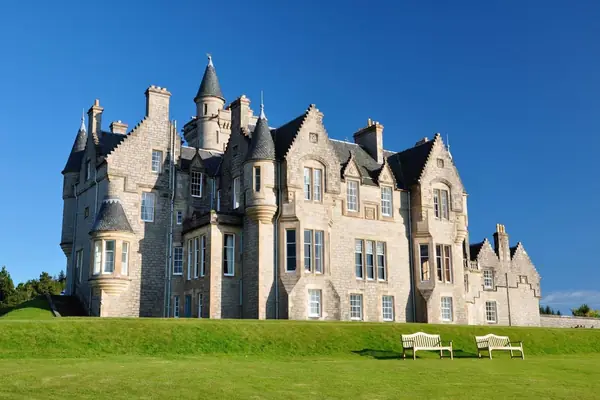
Level 4 Castle-Style Mansion
Tobermory, Isle of Mull
Some rooms inside the walls
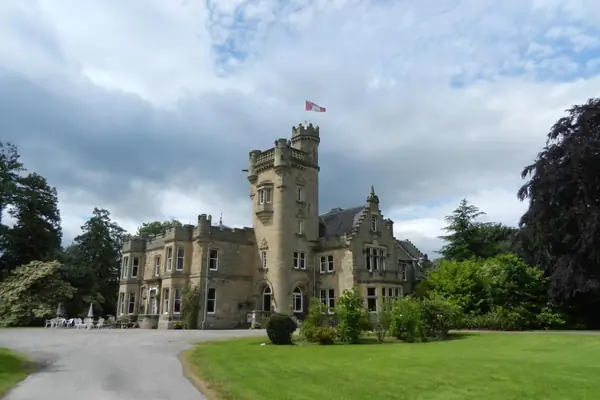
Level 4 Castle-Style Mansion
Tain, Ross-shire, Highlands
Some rooms inside the walls
Scottish Baronial is a building style based on the outline of Scotland's fortified tower houses: corbelled turrets, crow-stepped gables, bartizans and conical roofs on a tall main block. It covers both the genuine tower houses built between the 14th and 17th centuries and the 19th-century mansions built later to look the same way.
Scottish Baronial is usually treated as a Scottish branch of the wider 19th-century Gothic Revival, but it copies Scotland's own tower houses rather than English or French Gothic sources. Abbotsford, built for Walter Scott from 1816 to 1824, is generally credited as the building that started the Scottish version.
The style has two ages. Its source buildings, the tower houses, date mainly from the 14th to the 17th centuries. The Baronial revival that copied their outline for new country houses began with Abbotsford in the 1820s and stayed popular until the First World War.
Look for evidence of genuine defence: thick walls, a turnpike stair and small, irregular windows lower down the building, usually confirmed by a heritage-register listing. A Victorian mansion has the same turrets and crow-steps but wide sash windows, a symmetrical plan and no defensive history.
David Bryce is usually named as the architect who did most to spread Scottish Baronial in the 19th century, designing more than 230 buildings from his Edinburgh practice, including Glenapp Castle and the mansion now run as Glengarry Castle Hotel.
Last checked: September 2026. We checked these sources for this page. Spotted something out of date? Tell us.